World Community Cook Books

I have two World Community Cook Books that I think everyone would benefit by using.  The books were commissioned by Mennonite Central Committee to promote global understanding.  Simply in Season, (Lind & Hockman-Wert) promotes understanding of how the food choices we make affect our lives, the lives of the farmer /producers and the lives of others. Extending the Table  (Schlabach) promotes global understanding and celebrates the variety of world cultures.  Individuals share personal stories of those living in other cultures that will enlighten you about the realities of life and enrich your understanding of world cultures.  Both of these books are in the style of Less with More; a book/lifestyle that recommends how to utilize what we have to best advantage.

Simply in Season lists produce available by season and shares information about each fruit and vegetable: Description, Selection, Storage and Handling, Preparation, Serving Suggestions, and Nutrients.  Additionally the book features recipes utilizing the produce season by season.  This is a great reference especially for those fruits and veggies that you are unfamiliar with.

A recipe from Simply in Season, the Salad section:

Belizean Potato Salad, serves 6

Cook in salted water, then cool:

2 c potatoes, peeled and diced

1 c carrots, sliced

1 c peas

Combine with:

1 c cabbage, thinly sliced

1 c onion, diced

1 c mayo (or slightly less)

salt and pepper.

Chill several hours and serve on bed of lettuce garnished with parsley.


From Extending the Table, beverage section:

Tropical Fruit Shake, serves 4-5

Fill blender 2/3 full with any combination of fruit

strawberries, bananas, oranges, cantaloupe, papaya, peaches, pineapple, mangos, berries, watermelon, tomatoes and avacadoes

Add water to cover (or slightly less) and blend.

Add

several ice cubes

sugar to taste

lemon or lime juice to taste (optional)

Blend

Variation:  Add 1 1/2 c fruit and 3 cups milk, omit lemon juice and ice and blend till creamy.

Note:  In many parts of Latin America the blender is a sought-after household appliance.  It quickly liquefies fruits that people can then sell to their neighbors on hot days.  It also simplifies the task of pureeing cooked beans.


Posted in food preservation, Organization, Recipe | Tagged , , , | Leave a comment

Garden A Plenty!

basket of beans

Garden veggies are in full swing in Southern Indiana.  In my garden, green beans, cabbage, broccoli, zucchini, summer squash and cucumbers are producing rampantly.  The tomatoes and peppers are just ripening a few at a time and okra is just about to bloom which means I will have plenty to eat in just a few days. It’s a great thing to walk to the garden to get the groceries instead of driving to the grocery to get them.

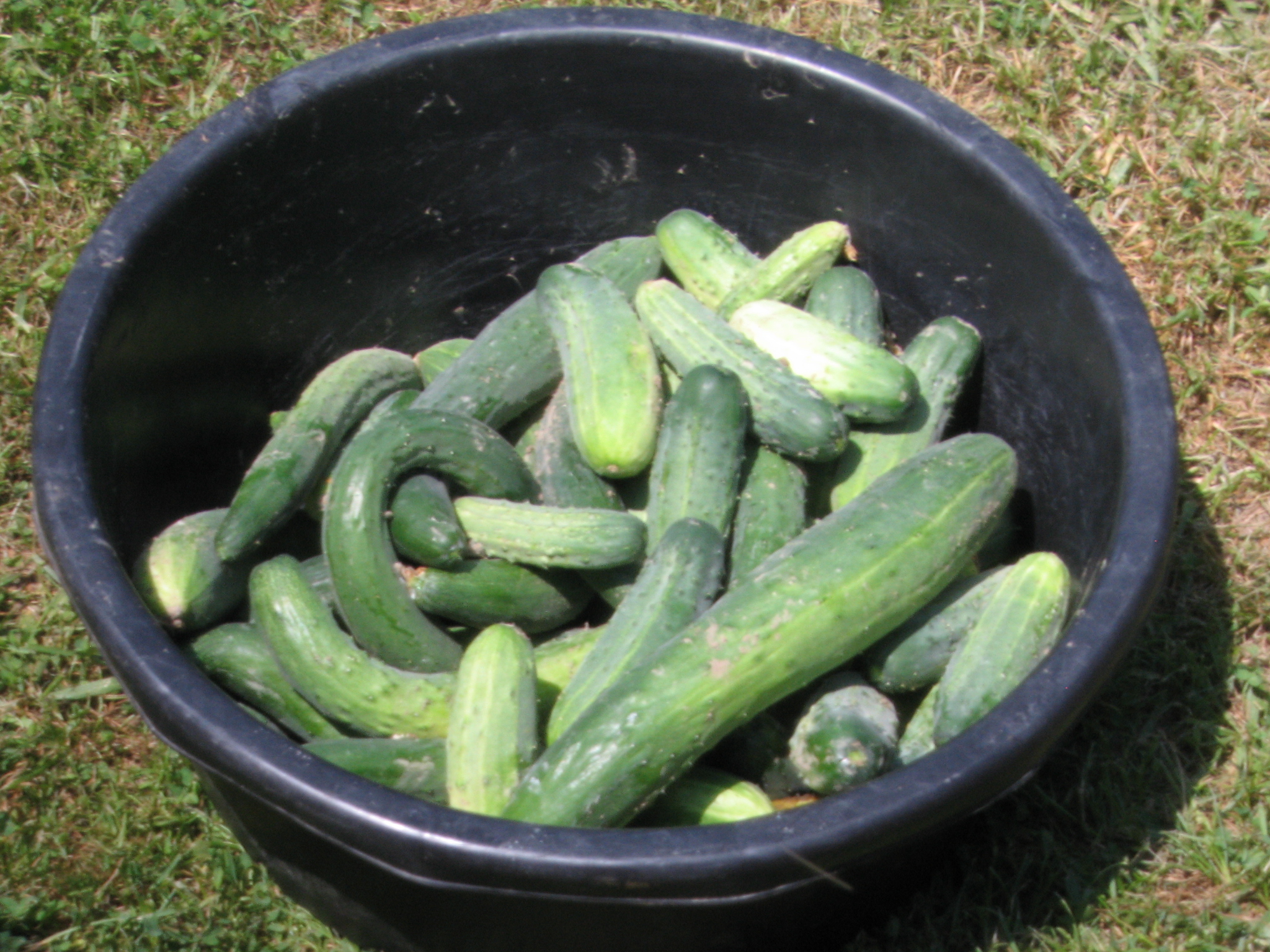
English and Pickle cucumbers

I canned green beans last week and should have enough to last the winter so the rest that we pick will be for fresh.  I sometimes freeze green beans to use in stir fry and soups; it depends how much freezer space I have.   Cucumbers can be used in salads of various kinds and even made into a refreshing cold soup that tastes great on a hot day.  An easy and quick salad is to wash a few cukes, slice and add mayo or sour cream; then stir.  If you like dill,  add to taste.  I usually add salt and just a pinch of sugar to complete the creamy sauce.  Just stir until all the slices are coated.   It tastes even better after marinating in the frig for a day.   My sister’s grandmother-in-law always added sliced onions to this.  I think it’s great either way but the fear of onion breath usually prompts me to leave the onions out.

I made sweet and dill pickles  last week.  I like the taste and crunch of fresh pickles better than canned but my frig can only hold so much and with all the produce I have now, I will can the pickles or find them a good home.  I will share a nice recipe for home made dills that doesn’t require much time or space.  You could use English (burpless) or Kirby cukes from the store if you don’t grow your own.  This could also be a great gift to give your hostess when you attend those summer “get-togethers” with friends and family.  The recipe makes 2 quarts and I suggest wide mouth canning jars and lids.  A nice touch would be to look for a glass jar with a wide opening and lid at garage sales, flea markets, or Goodwill.  Tie ribbon or rafia around the jar neck, add a home made label and  and you have a beautiful gift to share.

Dill Pickle Chips

2 pounds cucumbers (English or Kirby) non-waxed

3 Tblsp course salt

3 cups water

2 cups distilled white vinegar

1 Tblsp dill seed

4 cloves garlic

2 bunches fresh dill, coarsely chopped

Directions:  Cut the cukes into 1/2 inch thick rounds and transfer to a colander set in a bowl.  Toss well with salt and refrigerate for about 1 hour.

Rinse the cuke rounds well; drain.  Pat dry and transfer to to jars.

Bring 3 cups water, vinegar, dill seed, and garlic to a boil in a medium saucepan, stirring.  Reduce heat; simmer 4 minutes. Let mixture cool slightly, about 10 minutes.

Add chopped dill to jars and pour in brine. Wipe glass rim and top with lid.  Let cool completely.  Refrigerate for 1 week; then they are ready to eat.

* I also use small cukes and use them whole.  Just wash and cut ends off and proceed as directed above.

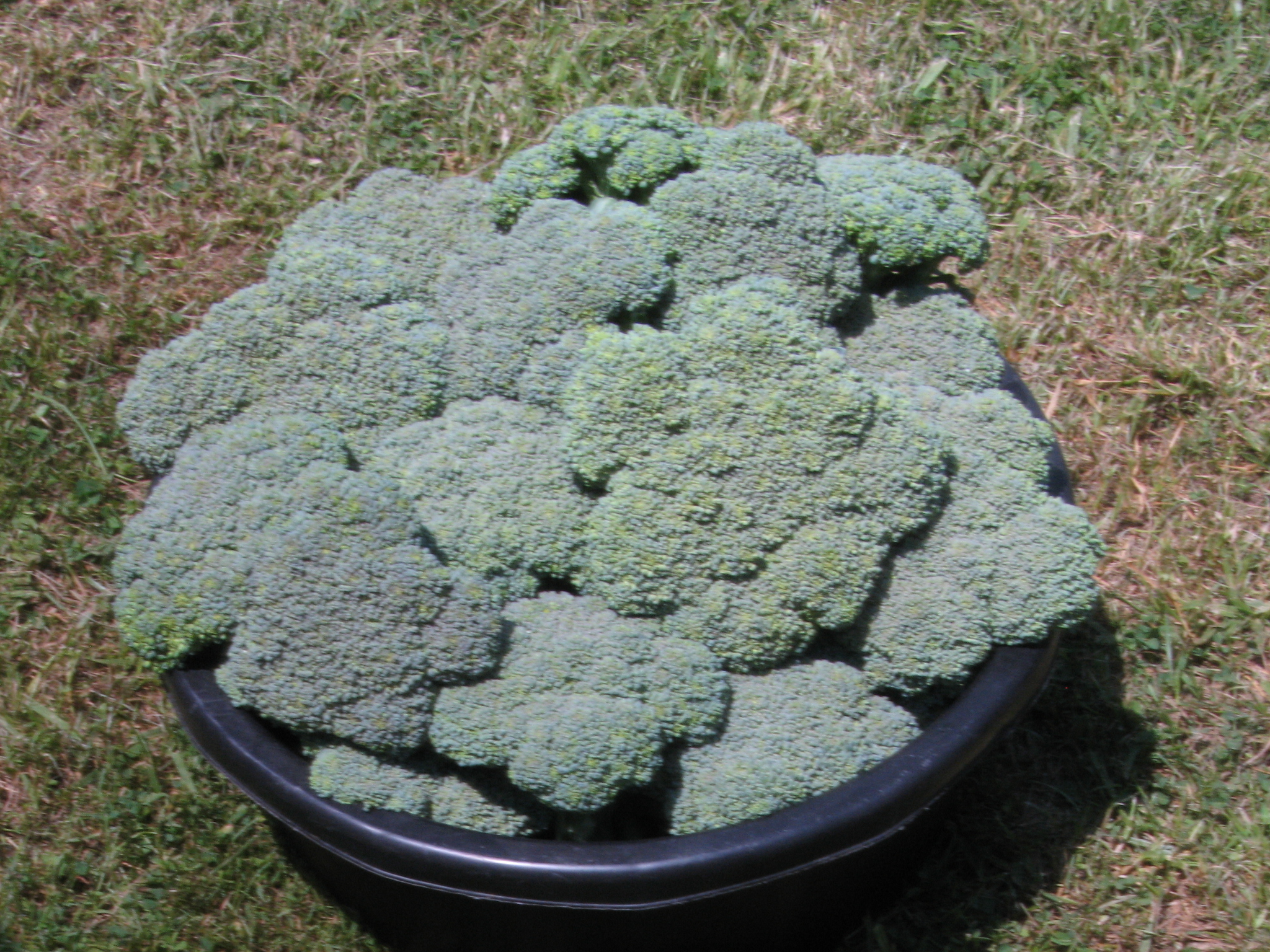
perfectly ripe

fresh from the garden

This years crop was the best ever broccoli I have  grown.  I recently cut about 25 heads which yielded over 7 gallons of broccoli to freeze.  The best thing was that it was so tender and contained no “surprises” in the form of little green catepillers.  My husband explained that because of the wet spring the cabbage moth could not fly nor lay eggs on my cold crop plants.  It’s those eggs that grow up into little green worms that eat broccoli, cabbage, cauliflower etc.  After the main head is cut the plant will produce side shoots that need to be cut every day or two to prevent them from flowering.  It is amazing how much broccoli you can get from healthy plants.   I keep the shoots in the frig for several weeks  in a vegetable bag to use as I wish.

Freezing broccoli is so easy.  Let me explain the process so you can give it a try.

Pick your broccoli early in the morning before the heat of the day or purchase at your local farmers market.  Sometimes the grocery stores  have broccoli on great sales and this would be a way of taking advantage of the extra produce.

If using home grown or farmer’s market broccoli strip the small leaves from the stem and bath in cold water with a hand full of salt added.  The salt bath is to remove unwanted guests (bugs and worms) from the heads.  After 15 minutes rinse and proceed.

Broccoli generally is cut into spears or small bite-size pieces.  If you are using fresh broccoli you can use all the stem because it will not be tough.  Cut into the size you desire and then prepare to blanch. 

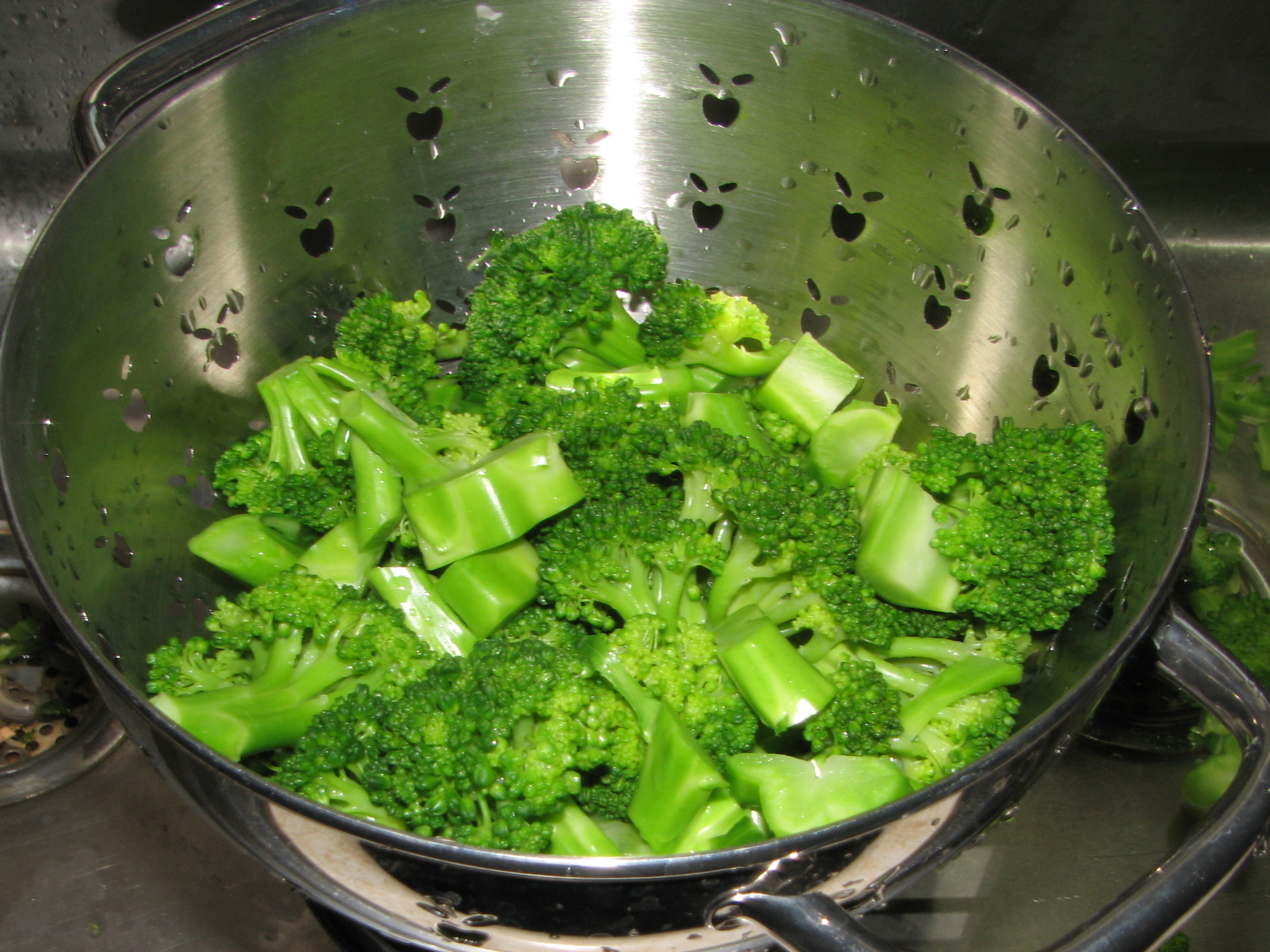
Blanching means that you cook the vegetable briefly in hot water; strain and immerse in ice cold water to cool quickly. Why? Produce continues to age after it is picked and will continue to age in the freezer if it is not blanched to stop the growth.  For fresh tender broccoli blanch the heads about 2 minutes and the stems for maybe 3 minutes.  If you are using broccoli that is a bit tough blanch for 3-4 minutes.  It  turns a beautiful shade of green.  Don’t over cook or it turns to mush! Immediately strain and dump the pieces into an ice water bath to cool; then strain into a colander to remove water; bag in freezer bags, label with the name and date and freeze.

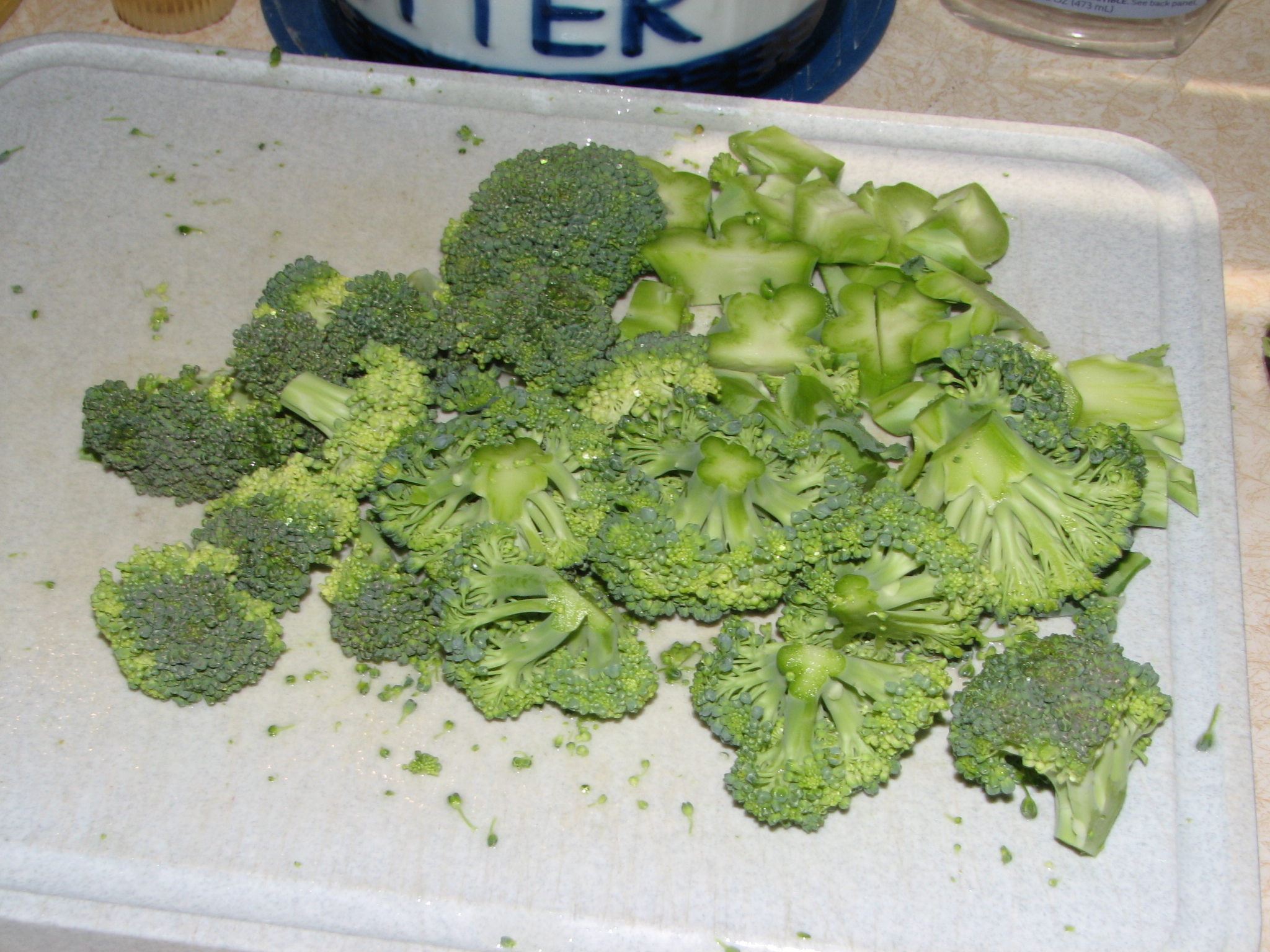
ready for blanching

Step 1: Cut into desired size pieces

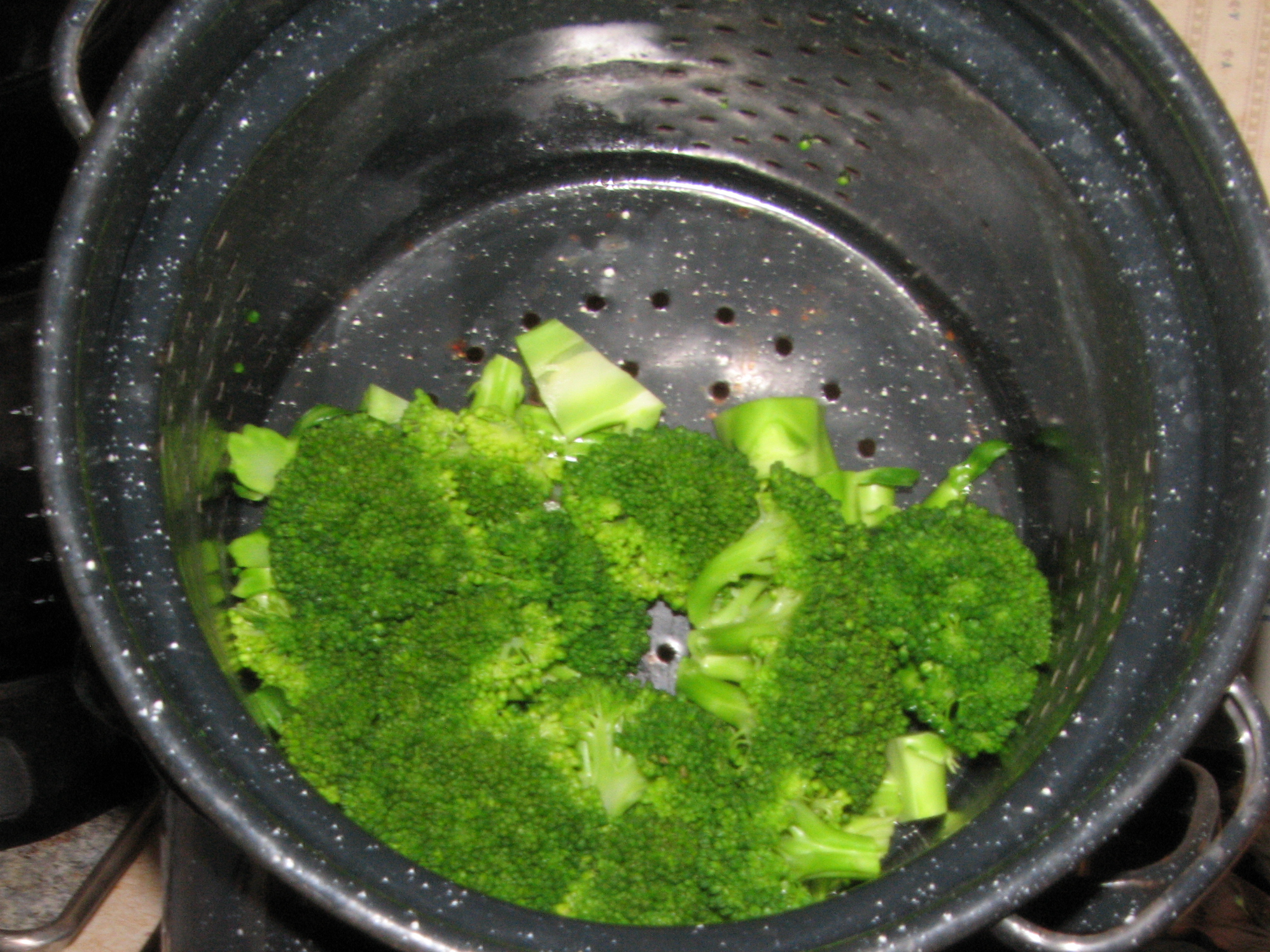
blanched broccoli strained and ready for cold water bath
Step 2: Blanch and strain

cooled broccoli

Step 3 and 4: Immerse in cold water bath and drain in colander

bagged, named, and dated
Step 5: Ready for freezing

You don’t have to purchase a blanching pot, just use a large stock pot; bring water to boil and blanch for the correct amount of time.  Strain with a slotted spoon or small strainer and place into cold water bath.  A blancher is nice.  It is like a pasta pot and has a strainer to make it easy to remove the blanched items. It is useful to cook ear corn too!

Another idea is to dry the broccoli to use to make cheese/broccoli soup this winter.  Cut into smaller pieces and dehydrate in a dehydrator  at appropriate setting or oven set to 175 degrees.  Dry until mildly pliable and bag.  This can be stored in the freezer or on your shelf.  You must blanch broccoli intended to be dried too so follow the directions above and then dry as your last step.

Hope this lesson in life’s simple pleasures has been helpful.  Give it a try  and you will thank yourself this winter!

Posted in DIY, food preservation, gardening, gift ideas, Recipe | Tagged , , , | 4 Comments

Blueberries for the whole year long

Blueberries are such a delight.  They taste great, are really good for you, and are one of the easiest fruits to preserve in order to eat all year long.  Early July is blueberry season in southeast Indiana.  To find out when blueberries are in season in your area check with your extension office or the local farmer’s market.  Look for “U Pick” berry patches in your area.  Blueberry plants are shrubs, not too tall,  and easy to pick.  If you can’t find any available from the farm or local market, it might be possible to ask your local grocery produce manager to order blueberries in 5 pound boxes.  It might be a good thing to educate the produce buyers that people in your area are interested in purchasing in bulk.

Once you have them home there are so many ways to eat them.  Over the Fourth of July weekend my family enjoyed homemade red raspberry and blueberry crepes, blueberry muffins, and blueberry pancakes.  The berries will keep several days in your refrigerator but don’t wash them till you are ready to use because they will go bad quicker after being washed.  Blueberries can be eaten fresh, frozen, baked into breads and cakes, made into syrup and jams, dried, and mixed into smoothies.

I prefer freezing blueberries rather than canning because they maintain the fresh taste and I can prepare them in a variety of ways.  Berries can be canned but generally after they have been made into syrup, jam, vinegar or pie filling.  If you have  a dehydrator you could also dry the berries.

To freeze the blueberry, sort and remove bad berries and remove stems.  Cover a baking sheet (must have sides) with a single layer of berries and place in your freezer until frozen.  Put the frozen berries in freezer bags ( in amounts your family can use in a short time span) and vacuum seal using a Food Saver.  ( Zip-lock freezer bags work too but vacuumed items keep much longer) Make sure to make a note of the fruit name and the date frozen on the bag using a sharpie pen, and always use the oldest products first when taking out of the freezer.  That is all there is to it!

Now to share some recipes!

Blueberry Smoothie

Blend 1 cup skim milk or soy milk, 6 oz vanilla yogurt, and 1 cup fresh blueberries plus a hand full of ice OR use frozen blueberries and no ice. Blend about 1 minute and serve.  An added nutritional element to be added is 1 Tablespoon of cold-pressed flaxseed oil.  It does not add any flavor but makes this shake a meal instead of a snack.  The oil is a monosaturate and helps stave off hunger for longer periods of time.


Crepes (for berries of course!)

You could of course add a savory filling to the crepes, but they work wonderfully for sweet fillings.

1 1/2 cup 2% milk

4 eggs

1 cup all-purpose flour

1 1/2 tsp sugar

1/8 tsp salt

8 tsp butter

In a small bowl, whisk milk and eggs.  Combine the flour, sugar and salt; add to milk mixture and mix well.  Refrigerate 1 hour.

Melt 1 tsp butter in an 8-in nonstick skillet over medium heat.  pour 2 Tblsp batter into center of skillet and tilt pan to coat the bottom.  Cook until top appears dry; turn and cook 15-20 seconds longer and remove to a cooling rack.

Repeat the process adding 1 tsp butter and 2 Tblsp to skillet until all batter is cooked.  When cool, stack crepes with wax or parchment paper until used.

To assemble a crepe:  Lay crepe out flat; Add a dollup of cool whip ( or the real thing if you desire) in the center.  Add berries to taste.  Sprinkle with sugar spiced with cinnamon and coriander.  Roll and garnish with a sprinkling of powdered sugar.

Blueberry Syrup (makes about 3 pints)

2 quarts blueberries

6 cups water, divided

1 Tablespoon grated lemon peel

3 cups sugar

2 Tablespoons lemon juice

Wash berries; drain.  Crush berries. Combine berries with 2 cups water and lemon peel in a medium saucepan.  Simmer 5 minutes.  Strain through damp jelly bag or several layers of cheesecloth.  Combine sugar and 4 cups of water in medium saucepan; boil to 230 degrees F.  Add blueberry juice to sugar syrup and boil 5 minutes.  Stir in lemon juice.  Ladle into hot jars, leaving 1/4 inch head space.  Adjust 2 piece caps. Process 10 minutes in boiling water bath canner.  Note: syrup is thin compared to maple syrup.  It can be thickened with cornstarch just before using.  Don’t add before canning.

Blueberry-Basil Vinegar

4 cups blueberries

4 cups white wine vinegar, divided

1 cup basil, loosely packed

zest of 1 lemon

Wash berries and drain.  Combine berries and 1 cup white wine vinegar in a glass bowl.  Add basil and lemon zest.   Cover bowl with waxed paper or plastic wrap and secure. Let vinegar steep in a cool, dark place for 4 weeks, stirring every 2-3 days. Strain vinegar through several layers of cheesecloth.  Heat vinegar to 180 degrees F.  Ladle into hot jars, leaving 1/4 inch head space. Adjust two piece caps and process for 10 minutes in boiling water bath canner.  Note:  1/4 cup fresh blueberries may be added to vinegar before canning.

Blueberry Pie Filling

6 cups sugar

2 1/4 cups clear-gel

7 cups cold water

1/2 lemon juice

6 quarts fresh blueberries

Combine sugar and clear gel in large kettle over medium high heat.  Add water.  Cook until mixture thickens and begins to bubble.  Add lemon juice and boil one minute, stirring constantly.  Fold in berries; fill hot jars leaving 1/2 inch head space.  Adjust lids and process immediately in boiling water bath canner for 30 minutes.

Blueberry Muffins

4 cups flour

1 tsp salt

2 eggs well beaten

3/4 cup oil

2 T sugar

6 tsp baking powder

1/2 cup sugar

2 cups milk

2 cups blueberries

Sift together flour, baking powder, salt and 1/2 cup sugar.  Combine eggs, milk, and oil.  Add all at once to flour mixture.  Stir until dry ingredients are moist, but still lumpy.  Fold in blueberries. Fill greased muffin pans 2/3 full.  Sprinkle with sugar (optional: cinnamon and coriander spice added to sugar).  Bake in 400 degree F oven about 25 minutes until lightly brown.

Tip Using frozen blueberries for baking

Coat the frozen blueberries with flour before adding to the recipe.  It will keep the berries from settling on the bottom and burning.

Now that you have several recipes and tips for freezing, Get out there and get some blueberries.  Try your hand at preserving  for eating during the off season.  Take time to enjoy Life’s Simple Pleasures.


Posted in DIY, food preservation, Recipe | Tagged , , , , , | 3 Comments

4H… a great youth organization

The past two weeks of my life have been focused on helping our youngest son complete participation in the 4H program for the year.  He took 4 goats and 2 quail for exhibition, as well as, recycling science and soybean projects.   Animal projects require a commitment from  child and parent but they offer learning moments 365 days a year as  needs occur day by day through caring for those animals.  Non-livestock projects don’t require near the time or resource commitment but offer “chunks of time” in which learning and skill development occur.

During the fair we spent nearly all of every day on the fairgrounds for 7 days feeding, watering, and cleaning pens to keep our 3 dairy goats, 1 pygmy goat and 2 quail comfortable and happy.  Our son exhibited the animals too which requires further care and training.  Goats must be shampooed and get a hoof trim in order to be show-ring presentable.  They also need a complete body clip to remove excess hair, and their ears, nose, and tail heads cleaned to make them look their best.  This doesn’t include the months of nutritional conditioning needed to keep them in show  and production condition.

What do kids learn?  They learn responsibility while caring for their animals every day spring, summer, fall, and winter.  They learn that taking care of others is just as important as taking care of themselves and is very rewarding.  They learn about interacting with nature.  They learn what  animals need in order to remain healthy and productive.  They learn about genetics as they select which animals to pair in order to improve offspring confirmation, strength, and productivity.  They learn about nutrition and health practices.  They learn about the importance of cleanliness and good herd management.  And they learn these animals offer products in return that can be used or sold.  Our goats give us milk, cream, yogurt, a variety of cheeses, goat milk soap and body products, livestock to sell or breeding program replacements, and most importantly, companionship and stress relief.  The quail give us eggs and one day perhaps fowl to eat, but for now they are entertaining to watch.

4H is one of those organizations, like Cubscouts, that gets the entire family involved.  4H is a national program administered by county extension offices and offers a wide variety of educational experiences for students grades 3-12.  My husband and I were both involved with the 4H program as children/teens and it was quite natural that we introduced our own children to the experience too.  While 4H is often thought of a program for “farm kids” because of the livestock projects, there are many learning opportunities for kids ranging from aerospace to zoology.  Our three older children all completed the 10 year program tenure and our fourth child just completed his 4th year….only 6 more to go.  Our kids have learned about cooking, sewing, fine arts and crafts, recycling, flowers, beekeeping, electricity, shooting sports, lawn and garden, entomology, soybeans, cake decorating, rockets and models, pocket pets, chickens, goats,  pigs and quail to name a few.  It is amazing how many topic choices are covered in the curriculum. Completing projects takes adult supervision and guidance for best student learning outcome; but it is definitely a learning by doing curriculum that reaches virtually all types of learners.    More than that, the families we have met through 4H have become our best support system in good times and bad.  4H is family oriented from beginning to end and the learning/skill developing activities are nearly limitless.

“4-H prepares young people to step up to the challenges in their community and the world. Using research-based programming around positive youth development, 4-H youth get the hands-on real world experience they need to become leaders. Through America’s 109 land-grant universities and its Cooperative Extension System, 4-H reaches every corner of our nation—from urban neighborhoods to suburban schoolyards to rural farming communities. With a network of more than 6 million youth, 540,000 volunteers, 3,500 professionals, and more than 60 million alumni, 4-H helps shape youth to move our country and the world forward in ways that no other youth organization can”. (www.4-h.org)

My husband and I believe in the program so much that we both volunteer our time and leadership serving on 4H or related boards of directors.  As an educator myself I witness the need for extending learning experiences for both parent and child on a frequent basis.  Teaching them to be functional contributing members of society frequently requires using the holistic approach to be most effective.  4H offers this approach, as it provides guidelines for learning and growing.  If you have time in your life, or even if you don’t, I suggest you check out the program and see for yourself what it has to offer your family.  Please visit the site listed above or contact your local 4H youth educator at the local extension office for further information.

Posted in Animal Care, bath and body products, DIY, Organization | 3 Comments

Vermiculture

composting for everyone

My son and I have been writing a report for a recycling project and thought you might find it interesting.  The worm project has been fun, economical,  easy and very do-able for my Down Syndrome son.  This is a great learning project for anyone wanting to learn about composting!  It would be a great project for any classroom, home, daycare, or senior center.

Recycling and Vermiculture

  • Composting is the process of collecting kitchen, yard, and livestock waste and allowing it to break down into usable dirt called humus.
  • Composting takes place over time as heat, moisture, and bacteria work together to break down “green” and “brown” plant material.
  • Composting is fun because you get to watch the recycling happen; unlike taking plastic, glass, cans, mixed paper, newspapers, and cardboard to the recycling bin and leaving it there.

Did you know the U.S. EPA estimates that each American throws away an average of 1.3 pounds of food scraps daily. The combination of this food waste, along with yard trimmings, makes up 24 percent of our nation’s municipal solid waste stream.

What is Vermiculture?

  • Vermiculture uses worms to decompose kitchen and yard waste into humus through vermicomposting.
  • Vermicomposting breaks down organic matter faster than regular composting.
  • Vermicomposting can be done inside or outside as long as the temperature is between 40 and 80 degrees F.
  • Vermicomposting can be managed in apartments and small containers.
  • Verimicomposting does not usually smell.
  • Worms love to eat your kitchen scraps except onions and citrus.

Did you know vermicomposting is done all over the world to help reduce organic waste in trash-dumps.  Some people make a living, and others supplement their income growing worms and making compost.

Setting up the Worm Bin

The worm farm

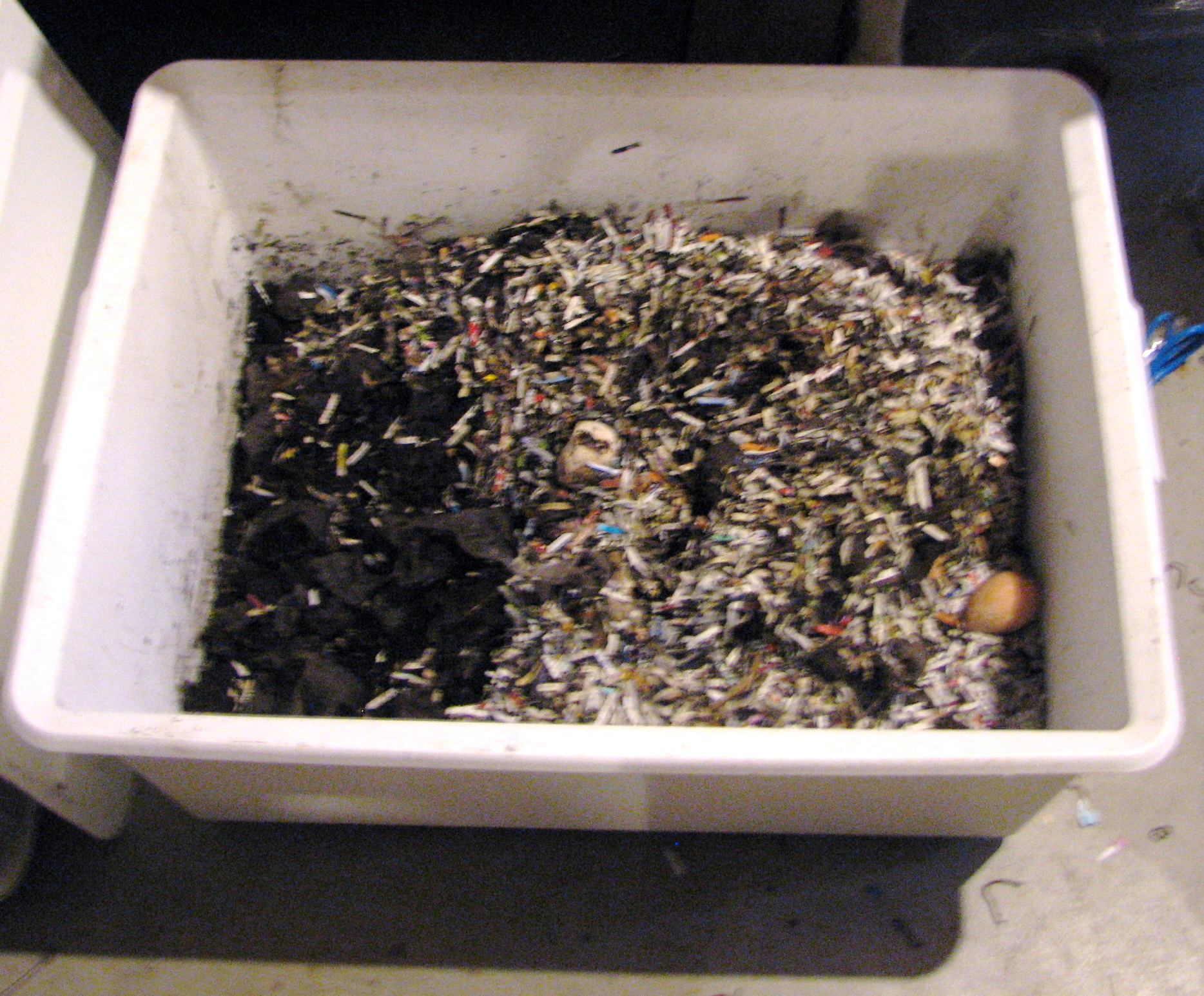
Worm bin with shredded newspaper bedding

  • You need a bin to grow the worms in.  You could recycle a dresser drawer, wooden box, or plastic tub.  Drill a few air holes for ventilation.
  • You will need a lid to keep the worms in the dark and keep the bedding moist.  Drill a few holes for ventilation.
  • In the bottom add about 1 inch of clean sand then sprinkle an inch or two of soil.  Top with 6-10 inches of shredded newspapers, dry leaves, or sawdust.
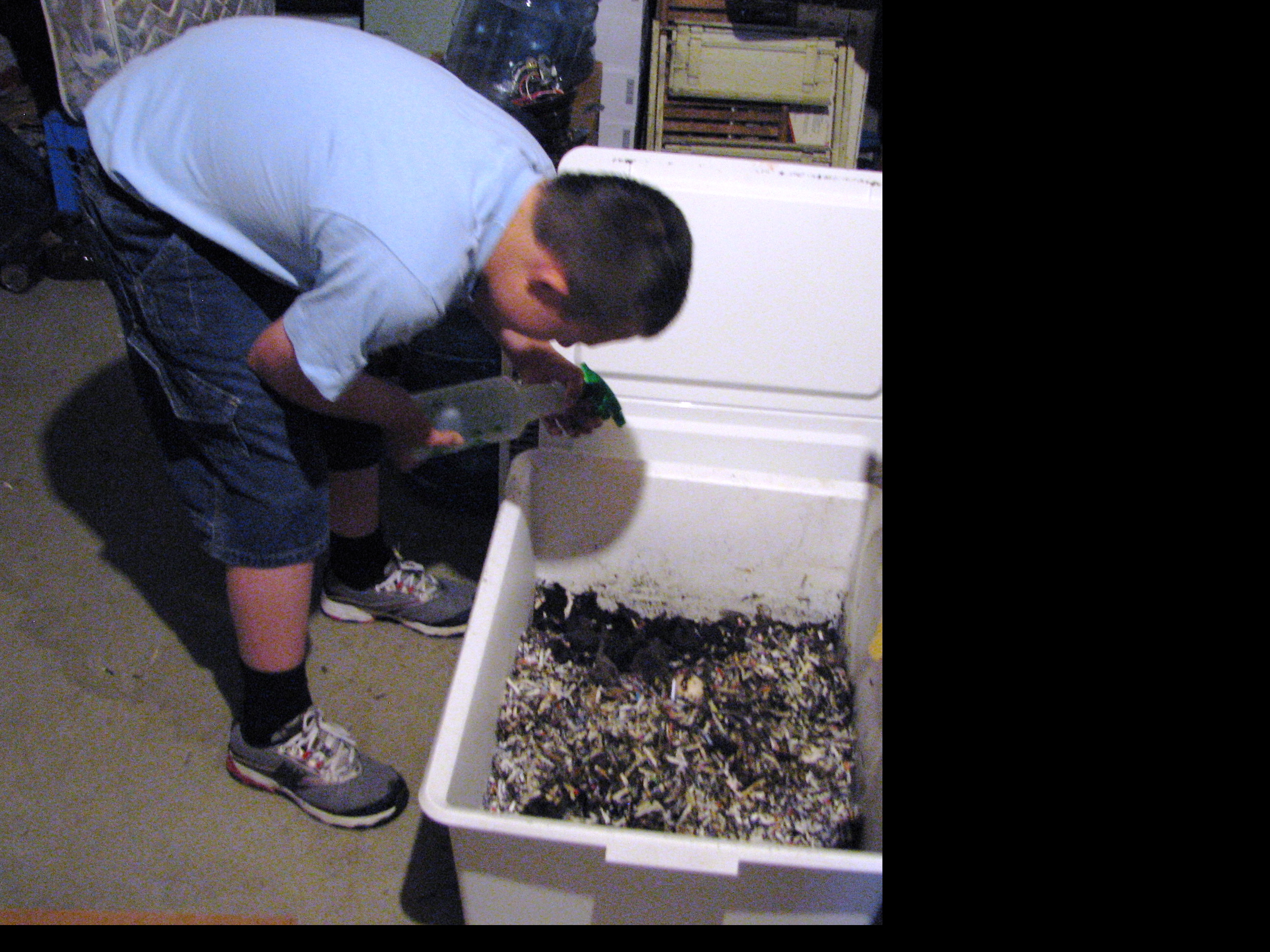
  • Mist the litter until wet but not spongy and continue misting each week to keep the soil moist.
moisture for worm farms

Misting the bedding is a weekly chore

  • Add worms.
  • Feed kitchen scraps once a week.   This can include coffee grounds and filters, vegetable and fruit waste, and egg shells.   Reduce the amount you feed if they don’t eat it between feedings.
  • Keep the worms fed and watered for about 2 1/2 to 3 months then remove 1/3 of the worms and compost, add new litter and begin again.

How many worms do I need to start?

  • The most frequently suggested compost worm is a red worm, or red wiggler. These worms reproduce quickly and can eat more than their own weight in food each day. Note that these are not the same as the earthworms you see on the sidewalk after a rainstorm.
  •  It is best to use 2 pounds of worms, or about 2,000 worms, for each pound of daily garbage. The average family of four generates about 7 pounds of compostable waste each week.

What do you feed the worms?

  • The worm-to-food ratio should be 2-to-1. Bury food at least 3 inches into the bedding, changing locations each time. But before burying it, remember that worms do not have teeth. It is much easier for them to eat if the food is blended or frozen and then thawed to be smaller and softer.
  • The following items can be put in the bin:

*Fruit and vegetable scraps

* Eggshells

* Grains

* Coffee grounds

* Tea bags

* Grass clippings and other yard waste

  • It is not recommended to compost meats, dairy products, oily foods and bones because of problems with odors and pests. Worms also do not like onion skins or citrus, so these may be used, but should be kept to a minimum.
Posted in DIY, gardening, Uncategorized | Tagged , , , , | 2 Comments

The Garden Paradise

I have spent the better part of the past week working in my garden and flower beds.  The spring was very wet and some of the seeds  successfully planted did not successfully germinate.  The weather turned cool and wet after planting and I am sure the poor little seeds rotted in the ground.  A  hard crust formed on the soil due to pounding rains and this hampered seed growth as well.  My garden paradise needed some TLC and quick, in order to secure our food supply.

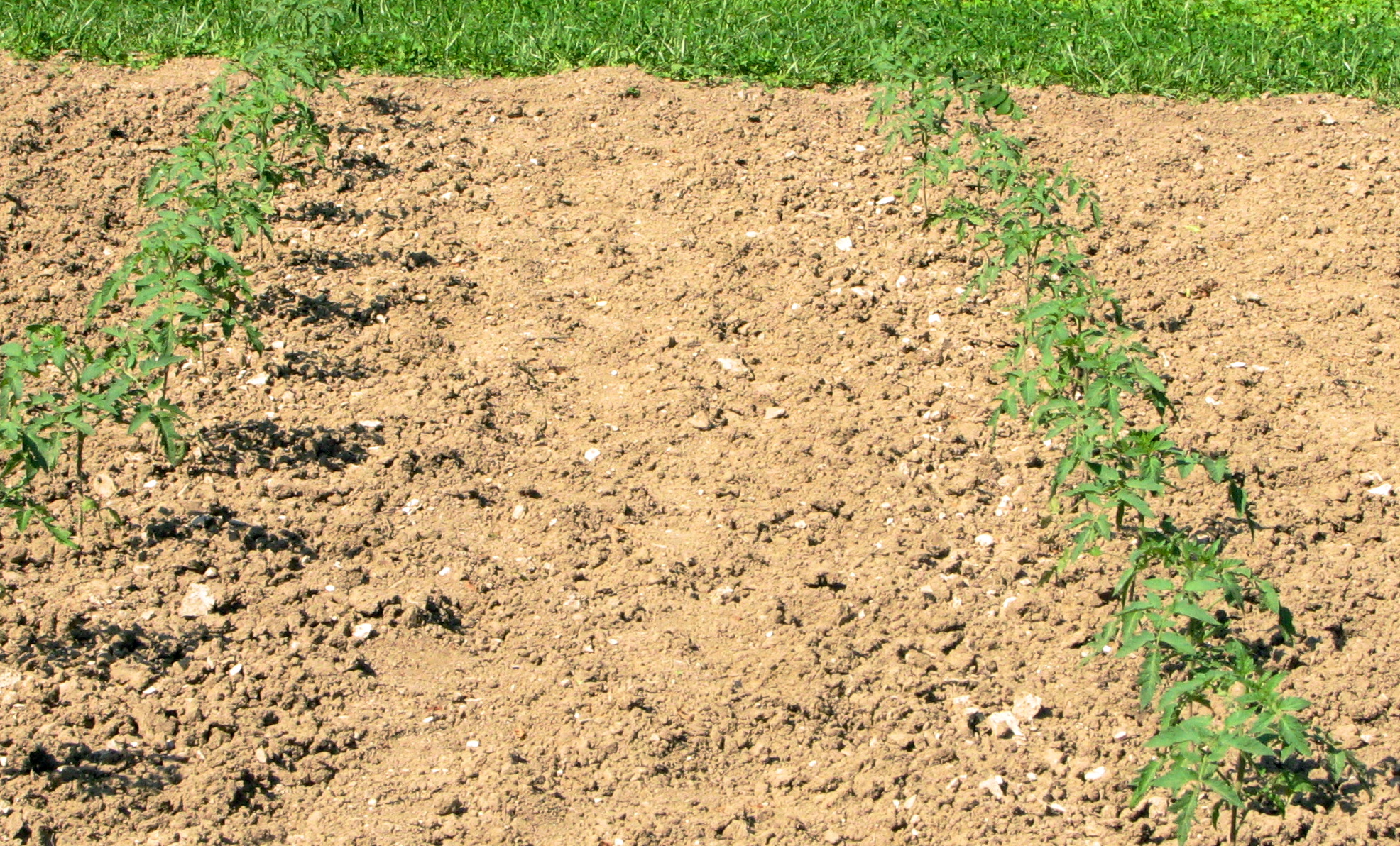
Weedfree and cultivated tomatoes

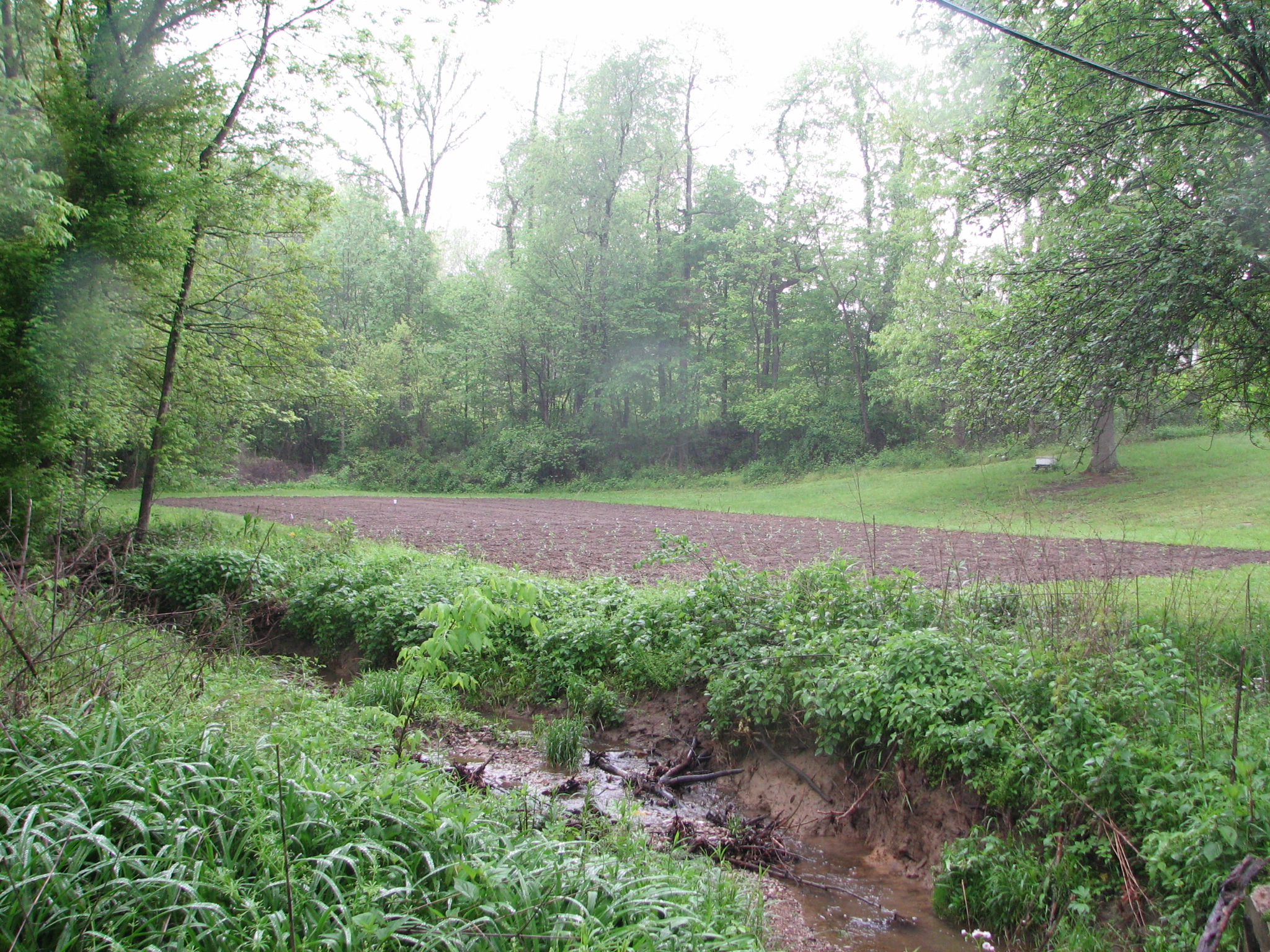
We are lucky to have a wonderful silty loam garden.  It sits on a plain next to a creek and generally provides more than enough vegetables to feed us for months.  It also provides food for the spirit.  I love to work in the garden; most of the time.  I love to look at the flowers in the garden all of the time!  I plant giant Zinnias that are rich in color and stand 3-4 feet tall.  Red, yellow, orange, white, red wine, lime, salmon, pink, and peppermint blend together to provide an aesthetically breathtaking palette of colors that draws me to the garden, as well as, total strangers, hummingbirds and butterflies.  While I was working this week a fellow passing by on a bicycle stopped and asked me to please make sure I got the flowers planted because it was the highlight of his daily trip to stop, take a break,  and enjoy my beautiful flowers before turning around and heading home.

As with most gardens, the hope is that it will be in constant production year after year.  This means we need to feed our gardens so they can in turn feed us.  Soil depletion is something to consider each year.  There are a few ways to feed the soil and you can take your pick as to how you want to add nutrients.

I try to work with nature to provide what it needs as much as possible.  Last fall we seeded annual rye grass in the garden before we put it to bed for the winter.  This spring we tilled the grass under to create what is called “green manure”.  Everyone recognizes the benefits of animal manure in the garden and flower bed, but many do not realize the benefit of plant material to enrich the soil.  As the plant material decomposes it releases nutrients to the soil and provides organic matter to enrich the tilth.

Another common soil enrichment is compost.  Composting is a process in which yard and garden waste is collected so that it can break down into soil over time.  You add the compost to the soil and till in to provide added nutrients for your plants.  Good compost requires both green and brown contributions.   A few years ago our local recycling organization was offering a composting class at our county fair and giving away a free kitchen compost container to participants.  I dragged my son and my husband to the class and registered to win a yard composter.  My son ended up winning the composter and it became his 4H recycling  project for the next year.  We collect vegetable waste from our kitchen, and yard waste throughout the year and add to the composter.  All it needs is an occasional stir and some moisture to help the organic material break down into usable compost.  My chickens are jealous now they must share with the composter, but my plants are happy.

Worm castings are a relatively new item used as fertilizer.  Harris Seed Company now grows worms with the intent of selling their castings (nice word for worm poop) to gardeners.  According to their research the castings do a great job feeding plants.  This year’s 4H recycling project for my son is growing “red wigglers” and harvesting the castings.  I have a few nephews that love to fish and they assure me I can sell the worms too as they make great fish bait!  We began our project in March with a large plastic container, 6-10 inches of shredded newspapers and a couple pounds of purchased worms.  You keep the worms in a cool place and feed them about once a week with kitchen scraps.  In the beginning we had to mist the paper with water each week to add moisture, but now the worms are established they create enough moisture themselves.  After about 2 months all but about 2 inches of the shredded newspaper is gone and the soil level is growing.  They suggest a harvest about every 3 months so we are getting close to our first harvest.  I will update you at that time with the results.

Yet another soil additive is commercial fertilizer.  If you are a naturalist this may be an offensive solution to feeding your plants, but if used properly and prudently, is quite beneficial to your harvest.  You can purchase this at any garden store; just make sure it is a relatively mild formulation (12-12-12) so it doesn’t burn the young plant roots.  Check the label for the distribution rate.  You might want to check with your local extension agent to help you determine what soil type you have and how much fertilizer is required if you are not familiar with these things.  There are several nutrients that soil needs in order to feed plants and a soil test will determine the state of your soil and what if anything needs to be added back.  I am lucky to have a soil scientist for a husband so I just ask him to handle the garden feeding regime each season.

It is also important to till the soil around young seedlings and transplants.  Weeds will outgrow most garden plants and out-compete them for nutrients, moisture, and sunshine.  Keep the weeds out of the garden and your plants will repay you with vigorous growth, health, and productivity.  I rototill between the rows and then come back with a hoe to weed and loosen soil around plant stems over the course of the growing season.  It is amazing how fast plants grow after cultivation!  You will need to continue to weed throughout the growing season as new weed seeds continue to germinate.  If weeds do establish themselves try to remove before they develop seed heads or you in essence plant weeds.

One last thing…check your plants frequently.  Weeds and compact soils are not the only things that kill plants.  Insect pests can kill plants within a few days by defoliating or transmitting diseases.  I check my garden nearly every day to ensure I stay on top of developments.

Hope these tips will help you enjoy the garden!

Create a private garden just for your eyes

Posted in gardening | Tagged , , , | 4 Comments

Vegetable Shampoo Soap Recipe

Homemade shampoo soap is a nice addition for the soapmaker.   It may seem odd to those used to a liquid shampoo, but shampoo can be made into hardened bars that produce a glorious lather.  The recipe below acts as both a shampoo and a conditioner.  Castor oil is a key ingredient in the following shampoo that differentiates it from body soap; as it offers a rich and lustrous lather  commonly equated with shampoo.  To use  bar shampoo, rub the bar back and forth across the top of the head to work up a lather.  Distribute the lather throughout the hair and massage.  Rinse as usual.

Any shampoo can leave a residue in your hair that weighs it down and dulls the shine.  Make your own rinse using 1 part apple cider vinegar, or lemon juice, to 1 part water, boiled and cooled.  Add 15-25 drops of your favorite essential oil and store in a spray bottle.  After shampoo and water rinse, spray and distribute the vinegar rinse through hair and scalp, then rinse well with water.

Ingredients

3 pounds cold water (distilled water optional)

510 grams sodium hydroxide

2 pounds 13 oz olive oil

2 pounds 4 oz castor oil (Make sure to purchase detoxified castor oil as the raw oil has a protein that is poisonous)

4 ounces jojoba oil

2 pounds 4 oz coconut oil

2 oz each of the following nutrients, (optional*):  shea butter, sweet almond oil, apricot kernal oil, avocado oil

30 grams grapefruit seed extract (natural preservative), optional

40-50 grams (approx 15-18 teaspoons) pure essential oil of your choice.

*If you do not use the nutratives listed above, increase the jojoba oil from 4 to 8 oz, and the olive oil to 3 pounds 1 oz.

Note:  The amount of sodium hydroxide has been increased to compensate for the use of castor oil.   

This recipe makes approximately 40 (4 ounce) bars.

This formula is for normal to oily hair type.

Preparation

Please refer to my soapmaking post for specific instructions on safety considerations, equipment and mold preparation.  Measure out essential oil, preservative, if used, and extra nutrients and set aside in separate tightly sealed containers.

Mixing Ingredients

1.  Put on goggles and gloves.

2.  Weigh out sodium hydroxide.

3. Put the 2 quart glass container or stainless pot on the scale (make note of weight) and add the required amount of water.

4.  Add sodium hydroxide slowly, mixing after each addition, until all the lye is dissolved.  Do this in a well ventilated room because there will be fumes!  Avoid breathing the fumes.  Set aside to cool.

5.  Set the soap making pan on the scale and weigh out olive oil, castor oil, jojoba oil, sweet almond oil, apricot kernel oil, and avocado oil.

6.  In a 3-qt sauce pan, set on scale, and weigh out the coconut oil.  Heat on low heat until most of the solids are melted.  Remove from heat and add shea butter.  Stir until all the solids are melted, and pour into the olive oil mixture.  If you are using a natural preservative, add at this time and stir to incorporate.

7. With both solutions at 80 degrees F, add the oil to the lye mixture slowly and stir after each addition. (Use an electric mixer on low/stir speed or a stainless steel wisk).  Continue to stir  to keep the solution in motion.  Do not scrape the sides of the pot.

8.  Trace occurs when a drizzle over the surface, sits briefly before melting into the solution.  Depending on the olive oil type used you can expect o stir for 10-40 minutes before trace occurs.

9.  Try to anticipate when you are getting  close to trace.  Add the nutratives and essential oils and incorporate entirely.  Essential oils frequently speed the trace, so work quickly to incorporate before it sets up too much to pour into molds.

10.  Quickly pour into mold.  Mixture should be smooth with no lumps, and a uniform texture.  If it begins to set use a spatula to spread over the mold in a uniform depth.

Cure & Cut

Cover the mold with plastic, heavy cardboard, or stiff board of some type, and top with a blanket to insulate.  Newspapers also help to insulate.  I usually place several inches of newspaper over the board and then top with a blanket.

Leave undisturbed for 18-24 hours!  During this time the soap will heat up to complete the saponification process.

After the required time, open the package and check for firmness.  If too soft, wait until they are firm enough to cut. These bars firm up quickly so don’t wait too long or they will be too hard to cut into nicely shaped bars.

I usually lift the soap from the mold with the freezer paper, then cut to desired size bars.  Trim the bars and then place on a screen frame to cure for 4 to 6 weeks. Cover with a towel to protect bars during the cure.

Wrap as desired in a breathable material.

*Recipe taken from The Natural Soap Book, Cavitch, 1995.

I hope this product enriches your appreciation of Life’s Simple Pleasures!  Please let me know what you think.

Posted in bath and body products, DIY, Recipe | Tagged , | 1 Comment

Family Recipes for Homemade Candy

My parents had a family friend who was a professional candy maker.  His name was Mr. Finn and he passed on his recipe for Caramels to my mother, who shared it with me when I was a teen in the kitchen.  I treasure the recipe because of the family connection and because these caramels are delicious!  One year for Christmas, I made pecan turtles to give as gifts using this caramel.  They did not last long.

When making candy you need a large heavy pot, wooden spoon to stir,  and a candy thermometer.

Mr. Finn’s Caramels

1 cup butter

2 1/4 cup brown sugar, firmly packed

1/8 tsp salt

1 cup light corn syrup

1 can (15 oz) sweetened condensed milk

1 tsp vanilla

Melt butter in sauce pan.  Stir in sugar and salt, then add corn syrup and mix well.  Add sweetened condensed milk, stirring constantly.  Continue stirring and cook to 245 degrees.  Remove from heat and st in vanilla.  Pour into 9″ buttered pan.  When cold, cut into squares and wrap.  Makes about 49 pieces.

Hard candy can be fun to make too, especially if you make it into suckers for your kids or favors for a special occasion. There are many candy molds available to choose from that make cute shapes.

4 cups sugar

1 cup Karo syrup (light corn syrup)

1/2 cup water

flavoring of your choice

Mix ingredients and bring to a boil.  Stir until 260 degrees.  Remove from heat and add flavoring.  Follow the mold instructions and carefully pour into molds; let set until cool.  Remove and store in a sealed container.

Another way to prepare this candy is to cover a shallow baking tray with muslin covered with confectionary (powdered) sugar.  Pour the candy and top with confectionary sugar.  When completely cool, lift from the tray with the cloth and break into bite size pieces.

If you have any homemade family candy recipes  you would like to share, I would love to add them to my collection.

Take time to take care of yourself; others are depending on you.

Posted in DIY, Recipe | Tagged , | 3 Comments

Seitan, the Wheat Meat….

I am not a vegetarian but I love many meatless dishes.  I love anything with beans and even enjoy a “Morning Star” Veggy burger upon occasion.  A friend of mine suggested I try a wheat gluten alternative called seitan.  I discovered a recipe for this eastern standard in my last copy of “Whole Living” magazine and thought others might like to give it a try too. 

Dough

2 1/2 cups vital wheat gluten flour

1/4 cup garbanzo bean flour

1/4 cup nutritional yeast seasoning

1 tsp garlic powder

1 tsp ginger

1/4 tsp coarse salt

1/4 tsp freshly ground black pepper

3/4 cup cold organic vegetable broth

3/4 cup cold water

1/4 cup Bragg Liquid Aminos or reduced sodium soy sauce

2 TBLSP extra-virgin olive oil

Broth

4 cups organic vegetable broth

4 cups water

1/4 Bragg liquid aminos

2 TBLSP fresh lemon juice

1.  Make dough:  Combine dry ingredients in a bowl and wet ingredients in another bowl.  Add wet ingredients to dry, mixing with a fork until blended completely.  Transfer dough to a clean, flat surface and knead by hand 10 times.  Let rest 3 minutes.  Knead 10-15 more times; let rest 15 more minutes.

2. Meanwhile, in a pot, bring broth ingredients to a boil. Reduce to simmer and cover.

3. Roll dough into a 3″ x 8″ log.  Cut crosswise into eight- 1/2 inch thick discs and flatten with hand to 1/4″ thick.

4. Add  discs to broth, cover, and simmer until the dough is as firm as the edges ( 1-1 1/2 hours). Add water if needed, to keep discs submerged in liquid during cooking.  Do not boil as this makes soggy seitan.  Remove from heat and let cool, uncovered, in broth.

Seitan, once cool, can be marinated, refrigerated in the broth for up to 1 week, or frozen individually in parchment for one month.

Seitan is a light, protein-rich addition to stir-fries, wraps, and soup.


Posted in Recipe, Uncategorized | Tagged , | 2 Comments

Garden Planting Tips

Pansies taking yet another drink of rain

The weather in southeast Indiana has been very wet this spring.  Wet weather means wet ground, which means frustrated gardeners.  I know because I was one until Friday, May 13th.  How unlikely is it that Friday the 13th turned out to be my lucky day?

I have been pestering my husband for weeks about tilling the garden and his response has been “patience is a virtue.”  I say that to him constantly so I deserved it this time.  He reminds me what I already know…..if you work the ground too wet you will regret it for the entire growing season!  Tilled too wet, the ground forms clods that cannot be worked out and seeds and roots need contact with soil to germinate and grow properly.

The tip for checking the soil is to use a shovel and dig as deep as you intend to work the ground.  The soil should break apart easily and if it is shiny at all, you need to wait till another day to check again.  My husband has been a farmer nearly all of his life and this advise always proves right.

He tilled it once the ground checked dry enough and then tilled again 2 more times the next day to help dry further.  He tilled again to level everything out before we actually planted anything.  I couldn’t wait to get started.  I had everything we needed garden-side by the time he was finished tilling.

What do you need to plant?

Gardens come in all sizes and designs and this determines what you need.  I am going to list the things I feel are needed to tend any size garden.

  • rototiller-a tiller that is pulled by a tractor is wonderful to till gardens prior to planting and at the end of the season before you put the garden to bed for the winter.  A hand tiller is necessary to maintain your garden once planted and throughout the growing season.  It is important to keep the soil loose to encourage optimum growth.  Most gardens need to be tilled at least once a week to remove weed growth.  Weeds hinder plant growth by taking the nutrients, moisture, and space that the plant needs.  Weeds can overtake a garden quickly and ruin your chances of getting a good harvest.
  • hand tools:  garden rake to move soil and gently cover seeds; hoe to space rows, remove weeds, dig planting furrows, and cover seeds; watering can to water transplants at planting time; garden gloves are optional but I find I wear them when using the hoe or rake and when pulling big weeds or when I pull plants at the end of their growing season.
  • Row marker-It is important to have straight rows because this makes it easier to get a tiller between the rows throughout the season.  A crooked row will plague you when the plants are at full maturity and blocking the aisle.  I use two sticks of lumber or wood and tie a string between them long enough to cross the width of the garden so I can make sure the rows are straight.  I  mark lengths on the handle of my hoe to quickly space the distance between rows or plants.  (1ft, 2ft, 3ft, 4ft, 5ft, 6ft).  Make sure your rows are square to the garden so the sun will shine equally on both sides.  Use individual row markers to designate where your rows are until the plants come up.   Ready made markers can be purchased but I prefer to use wooden crafting sticks that I write the plant name on with a sharpie marker.  These are inexpensive but functional and if they get tilled up accidentally ….no worries.
  • Planting devices-I have an Earthway, Precision Seed Planter that saves a lot of time and back strain.  It is a very manageable size, has hand holds,  two wheels, a seed hopper, row marker and planting plow.  There are several seed plates to use depending on the size of your seeds.  The seed plate makes sure seeds are dropped at just the right distance from each other and a chain follows behind to cover the seeds once dropped.  Of course you can also use a hoe to dig a shallow furrow and place the seeds in by hand, making sure to space them at the recommended spacing on the seed packet.  Then use the hoe or rake to gently cover them with the recommended amount of soil.

The Process

Once the ground is tilled and the soil is fine and loose head to the garden with all your tools assembled.  Use the wooden stakes and string to line up a straight row.  I use my hoe handle to measure distance to keep the rows plum and true.  You can use your eye to “sight out” a straight line, but I find my eyes a bit deceiving sometimes….

It is time well spent if you create a planting grid of your garden each year.  Take time to think about the needs of all the plants you intend to grow and then determine where they would best have their needs met.  It is also important to rotate the locations where vegetables are planted from year to year to help reduce diseases and maintain soil tilth.  Different plants have different nutrient needs and planting the same plant in the same area year after year can deplete the soil of essential nutrients.

Many vegetables can be direct seeded into your garden.  Once your grid is set begin planting rows maintaining the distance between rows as indicated by the seed packet.  Lettuce, carrots, beets, beans, etc require much less distance between rows than zucchini and other types of squash or melons.  Make sure to leave enough room at the end of the rows to get the tiller around.   Use planting markers to designate what is planted where in the row.  This is helpful until the seeds have germinated, but also if you need to check what variety of plant you planted for future reference.

new transplants

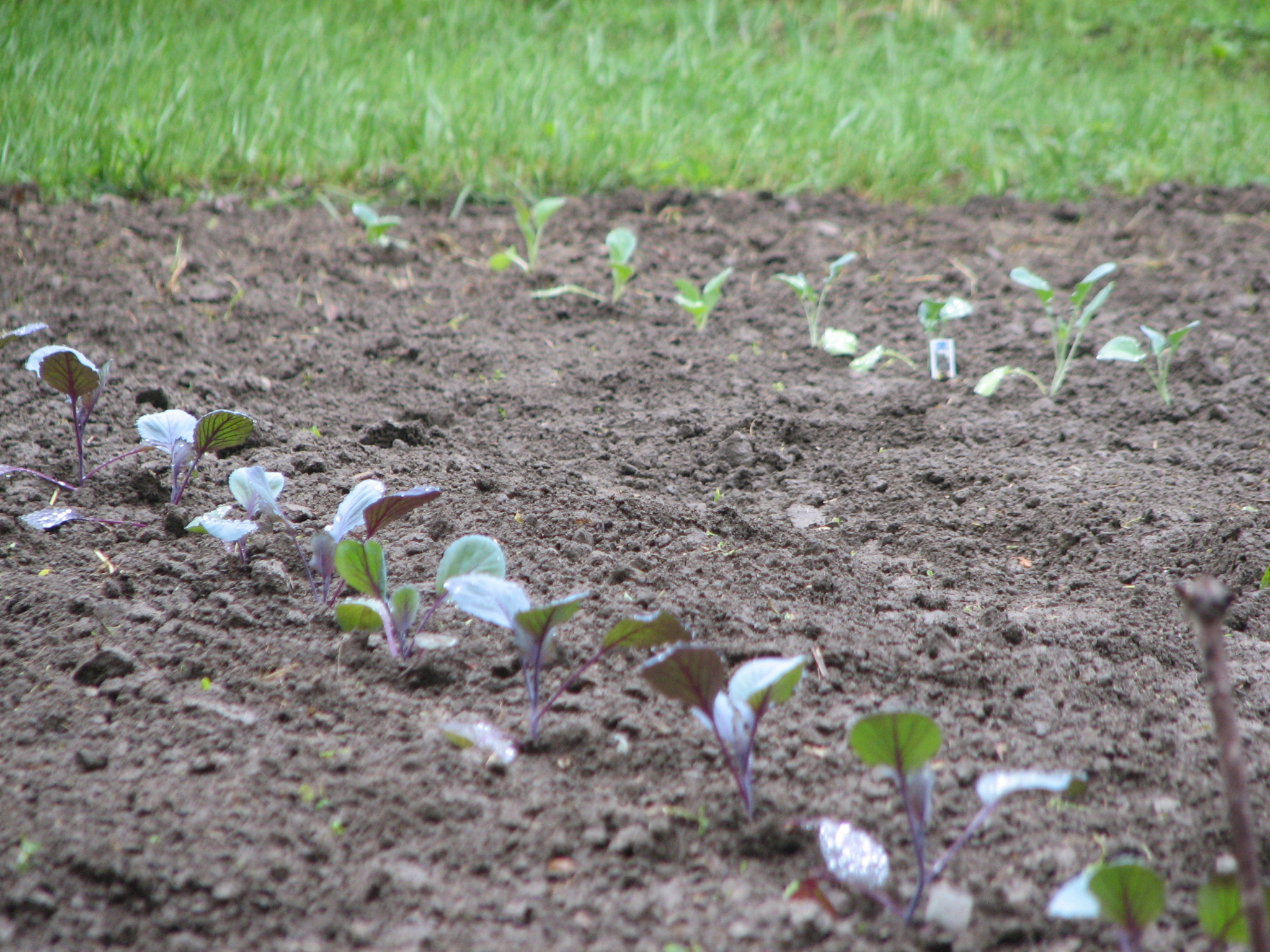
There are a few garden plants that need to be started early in the spring to get the proper amount of growing time in order to harvest.  In the Midwest, tomatoes, peppers, cucumbers, melons, cabbage, broccoli, cauliflower and eggplant should be planted as transplants.  Mark rows and dig planting holes as recommended.  Make sure the plants have been watered before you try to take them out of the pack trays or all the dry dirt will fall off the root pack.  Gently invert the tray and push the plant out and place in the hole.  Move some soil around the root ball to secure in place and if the soil is dry, water each plant then cover with remaining soil to secure the plant in the ground.  Make sure there is not a well around plant stems or this could pool water and rot the stem. The best time to transplant is when it is cool and overcast or in the evening when the heat of the day is past.  Don’t panic if your plants flag or appear to wilt for a day or two after planting.  Transplanting, and hot and dry weather also cause stress.  Within a few days from transplanting plants will begin to take off and grow once the roots have become established.

Fertilizing transplants is recommended to get them started.  Compost or worm castings are natural materials that will feed the plants well.  If you use commercial fertilizer use anything that has equal amounts of nitrogen, phosphorous, and potassium such as triple 12 or 15.  Too much nitrogen will leach from the ground and can burn roots.  Application can be made by mixing the fertilizing agent with the soil in the hole at planting, side-dressing the plants  after planting, or watering the plants with a “fertilizing tea.”  You may need to fertilize again during the growing season but be careful not to over-fertilize as this promotes green growth, not necessarily vegetable production.

After your garden is planted it will need to be tilled at least once a week in most cases to keep the soil loose and destroy the weed population.  You will need to hoe between plants to help plants grow vigorously.

Once established some plants need to be staked, trellised, or mulched in order to produce the maximum.  Peas and cucumbers thrive being trellised.  A net provides support for the plants to secure themselves to.  Tomatoes should either be staked or mulched well to prevent weed overgrowth and fruit rotting on the ground.  Peppers have a tendency to get willowy and may benefit from staking, especially when they are heavy with fruit.  If you grow string beans, you will need to provide a trellis or tripod for them to “run” on.

If you are new to gardening give it a try!  Digging in the dirt is great exercise, gets you outdoors in the fresh air and sun, and for many, offers a great way to relax.  Eating the food you grow is wonderfully rewarding and children are tempted to eat vegetables they have helped grow and pick… .

If you have specific questions, I will be glad to help you out.  If I don’t know the answer, I know my husband will.


Posted in gardening | Tagged , | 4 Comments